
Best AI Tools in 2026: Complete comparison by use case
Discover the best AI tools in 2026. ChatGPT, Claude, Gemini, Midjourney & more. Compare AI by use case: writing, images, coding, business.
EN - AI
Quebec Test
1/7/20266 min read
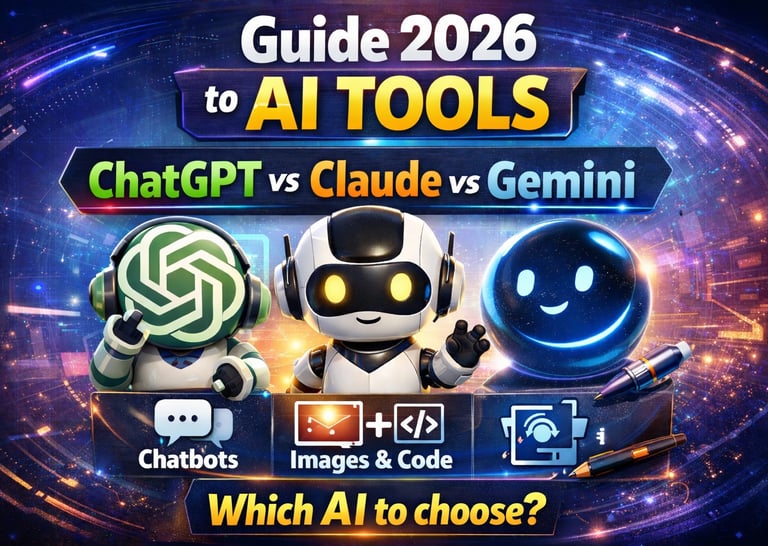
Artificial Intelligence is no longer a trend—it is a core productivity tool. In 2026, AI tools have become more specialized, powerful, and accessible. Whether you are a creator, developer, entrepreneur, or professional, choosing the right AI can significantly impact your efficiency.
This guide provides a clear, practical comparison of the best AI tools in 2026, categorized by real-world use cases.
Best AI Chatbots & Conversational Assistants


ChatGPT – The Versatile Pioneer
Developed by: OpenAI
🔗 https://chat.openai.com
ChatGPT remains the most popular and versatile AI assistant in 2026. Since its launch in 2022, it has democratized access to conversational AI.
Key strengths:
Intuitive interface
Text, code, image, and document generation
Custom GPTs for specialized tasks
Web browsing and document analysis
Excellent multilingual support
Available models (2026):
GPT-4o (multimodal)
GPT-4.5 (creative)
GPT-4.1 (coding & analysis)
o3 (advanced reasoning)
GPT-5.2 (latest flagship – reasoning & autonomy)
Best for: Writing, brainstorming, coding, technical assistance
Claude – Ethical & Reliable AI
Developed by: Anthropic
🔗 https://claude.ai
Claude focuses on safety, clarity, and long-context understanding.
Key strengths:
Excellent long document analysis
Reliable reasoning
Strong HTML/CSS and code explanations
Natural, nuanced responses
Best for: Research, legal/technical documents, development workflows


Google Gemini – Deep Ecosystem Integration
Developed by: Google
🔗 https://gemini.google.com
Gemini shines through its deep integration with Google Workspace.
Key strengths:
Gmail, Docs, Sheets & Drive integration
Real-time web access
Strong factual grounding
Image and short video generation
Best for: Productivity, research, business users

Mistral AI – Open & European
Developed by: Mistral AI
🔗 https://mistral.ai
Mistral AI offers powerful open-source and commercial models with a strong focus on data sovereignty.
Key strengths:
Open-source models
European data hosting
Excellent French language support
Best for: Developers, enterprises, privacy-focused users
Perplexity AI – AI Search Engine
Perplexity AI acts as a hybrid between a search engine and an AI assistant. Its main strength lies in providing concise answers backed by cited sources, reducing hallucinations.
Key strengths:
Source-based responses
Fast research summaries
Excellent for fact-checking
Limitations:
Limited creative writing
Less conversational depth than chatbots
Dependent on source quality
Best for:
Journalists, researchers, students, and fact-driven workflows.
Privacy note:
Search queries may be logged; avoid sensitive research topics.


Grok – Unfiltered & Real-Time Conversational AI
🔗 https://grok.x.ai
Developed by: xAI
Grok is an AI assistant designed to provide a more direct, less constrained conversational experience. Unlike traditional assistants, Grok emphasizes real-time awareness and informal interaction, especially when connected to live social data.
Key strengths:
More candid and conversational tone
Real-time context awareness
Good for trend analysis and open-ended discussions
Limitations:
Less suitable for professional or structured writing
Limited long-document analysis
Fewer productivity integrations
Best for:
Exploratory conversations, trend monitoring, informal AI interactions.
Privacy note:
Depends heavily on platform integration; not ideal for sensitive data.

Midjourney – Professional Artistic Image Generation
Midjourney is widely regarded as the gold standard for artistic and cinematic AI-generated images. It excels in style consistency and visual impact.
Key strengths:
Exceptional artistic quality
Strong prompt interpretation
Consistent visual styles
Limitations:
No free tier
Limited image editing tools
Discord-based workflow may deter beginners
Best for:
Designers, artists, content creators, thumbnail creation.
Privacy note:
Generated images may be public depending on subscription tier.
Best AI Image Generators
AI image generation has reached a professional level in 2026. These tools are no longer just experimental—they are now used daily for marketing visuals, YouTube thumbnails, product mockups, social media content, and even commercial design work.
Each AI image generator has its own strengths: some focus on artistic quality, others on text accuracy, ease of use, or advanced customization. Below is a curated comparison of the best AI image generators in 2026, based on real-world use, output quality, and creative control.
DALL·E 3 – Accessible Image Creation
DALL·E 3 focuses on accessibility and prompt accuracy. Integrated into ChatGPT, it is ideal for users who want quick, reliable image generation.
Key strengths:
Excellent text-to-image accuracy
Easy refinement through conversation
Strong moderation and safety controls
Limitations:
Less artistic freedom than Midjourney
Fewer advanced controls
Best for:
Marketing visuals, blog illustrations, social media images.
Privacy note:
Images follow OpenAI content policies and moderation.


Ideogram – Text-Perfect Image Generator
Ideogram stands out for its ability to generate images with readable, accurate text—a common weakness in AI image generators.
Key strengths:
Excellent text rendering
Clean graphic design output
Fast generation
Limitations:
Less artistic depth
Limited advanced controls
Best for:
Posters, ads, thumbnails, banners.

Leonardo AI – Advanced Creative Control
Leonardo AI offers a full creative suite combining generation, editing, and fine-tuned model control.
Key strengths:
Style consistency
Image editing and upscaling
Advanced presets
Limitations:
Learning curve
Credit-based pricing
Best for:
Game designers, illustrators, advanced creators.


Stable Diffusion – Open-Source Image Generation
Stable Diffusion is an open-source image generation framework that offers maximum customization and self-hosting options.
Key strengths:
Full control over models
Offline / self-hosted usage
Strong community support
Limitations:
Requires technical knowledge
Hardware-dependent
Best for:
Developers, privacy-focused users, AI researchers.
Privacy note:
Excellent when self-hosted; full data control.
Canva AI – Simple Design for Everyone
Canva AI integrates AI tools directly into an easy drag-and-drop design platform.
Key strengths:
Extremely user-friendly
Integrated text, image, and layout AI
Ideal for social media
Limitations:
Limited creative depth
Less control than pro tools
Best for:
Beginners, small businesses, marketers.
AI for Customer Support & E-Commerce
Ringover AI Assistant – Omnichannel Support AI
Ringover AI assists customer support teams across calls, chat, and CRM platforms.
Key strengths:
Omnichannel support
Call transcription and summaries
CRM integration
Limitations:
Enterprise-oriented pricing
Less relevant for individuals
Best for:
Sales teams, customer support centers.
Shopify Inbox (AI) – E-Commerce Messaging
🔗 https://www.shopify.com/inbox
Shopify Inbox integrates AI chat directly into Shopify stores to handle customer inquiries.
Key strengths:
Native Shopify integration
Automated replies
Simple setup
Limitations:
Shopify-only
Limited customization


Trengo AI HelpMate – Automated Customer Support
Trengo AI automates customer interactions across messaging platforms like WhatsApp and email.
Key strengths:
Multi-channel automation
Workflow optimization
Team collaboration tools
Limitations:
Requires setup
Not designed for creators


AI for Development & Programming

Cursor – AI-First Code Editor
Cursor is an AI-native IDE designed for deep codebase understanding.
Key strengths:
Full-project context
AI agents for refactoring
Fast iteration
Limitations:
Learning curve
Best suited for advanced users
GitHub Copilot – AI Coding Assistant
🔗 https://github.com/features/copilot
GitHub Copilot provides real-time code suggestions inside IDEs.
Key strengths:
Speeds up development
Multi-language support
Context-aware suggestions
Limitations:
Requires review of output
Subscription-based
Manus AI – Autonomous Task Agent
Manus AI executes multi-step workflows autonomously.
Key strengths:
Task automation
Agent-based execution
Productivity gains
Limitations:
Early-stage
Requires clear instructions
AI for Productivity & Automation
Notion AI – Smart Knowledge Assistant
🔗 https://www.notion.so/product/ai
Notion AI enhances documentation, summaries, and project management.
Key strengths:
Seamless workspace integration
Content summarization
Writing assistance
AI for Audio & Video Content
🔗 ElevenLabs – AI Voice Generation
ElevenLabs produces some of the most realistic AI voices available.
Key strengths:
Natural voices
Multi-language support
Voice cloning
Limitations:
Ethical considerations
Subscription pricing
HeyGen – AI Avatars & Video Creation
HeyGen allows users to create AI-generated videos with avatars and dubbing.
Key strengths:
Professional avatars
Multi-language video translation
Fast video creation
Limitations:
Less suitable for cinematic content
Subscription required
How to Choose the Right AI in 2026
Ask yourself:
What is my primary use case?
Do I need accuracy or creativity?
Is data privacy important?
Do I need integrations?
Major AI Trends in 2026
Multimodal AI (text, image, audio, video)
Autonomous agents
Vertical specialization
Privacy & sovereignty focus
Conclusion
There is no single “best AI”—only the best AI for your needs.
For most users in 2026, a solid stack includes:
ChatGPT + Claude + Midjourney + Gemini + Perplexity
Sources
Québec Test – Original French article (2026)
Official websites of each AI tool listed above